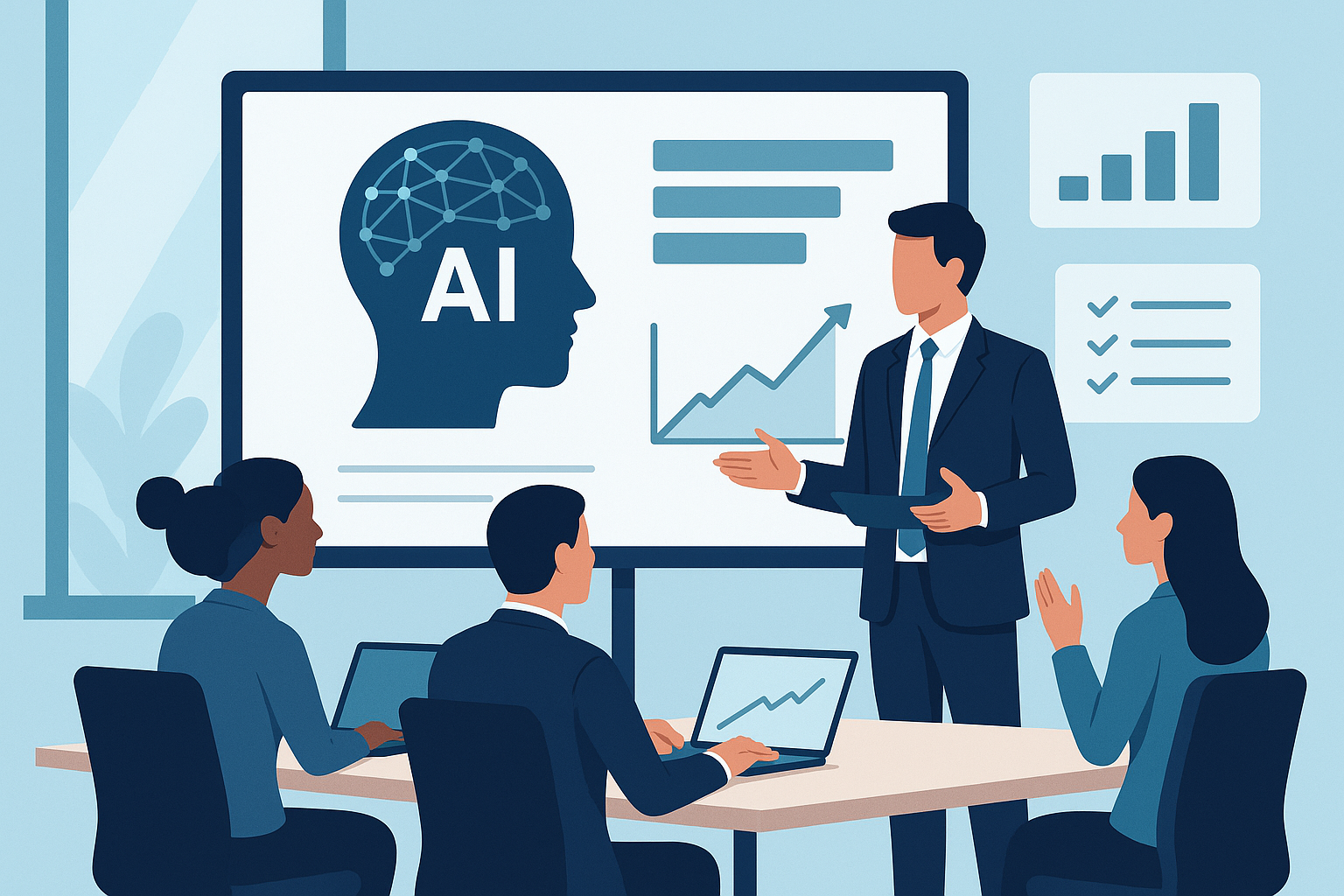
Implementing an AI Workforce: Strategies for Boosting Corporate Performance in 2026
Executive summary and objectives
Organizations that treat AI as an enterprise capability-not a point technology-realize sustained performance gains. This guide provides practical, strategic, and operational guidance for business and technology leaders on AI workforce implementation strategies for corporate performance. It frames why an AI workforce matters, presents comparative methodologies and frameworks, offers a seven-step roadmap for deployment, and delivers KPI systems, execution workflows, tools reviews, and a view of 2026 trends.
Objectives:
- Define proven methodologies and governance models for an AI-enabled workforce.
- Provide a clear, seven-step implementation roadmap from strategy to continuous improvement.
- Recommend KPI systems, dashboards, and measurement frameworks to track adoption, productivity, ROI, and risk.
- Supply execution playbooks, RACI templates, and CI/CD workflows for model and product delivery.
- Assess leading tools and performance-assessment approaches and forecast key 2026 advancements.
Core methodologies and frameworks (comparative list)
Selecting the right operating model and governance approach is the foundation of effective AI workforce implementation strategies for corporate performance. Below are core frameworks, a short description of each, and guidance on when to apply them.
1. Centralized AI Center of Excellence (CoE)
Description: A centralized team defines standards, builds reusable models, and provides shared services (MLOps, data engineering, governance).
Best for: Organizations needing strong standardization, efficient reuse, and consistent governance across business units.
2. Federated / Hub-and-Spoke
Description: A central hub provides tooling and guardrails while business units maintain local model development and ownership.
Best for: Large enterprises balancing autonomy and control; supports faster domain-specific innovation with central oversight.
3. Embedded AI (AI-native teams)
Description: AI practitioners are embedded directly into product and operations teams; models become part of team OKRs.
Best for: Organizations prioritizing rapid product integration and human+AI workflows with tight feedback loops.
4. MLOps and Model Lifecycle Management
Description: Focused practices and tooling to develop, deploy, monitor, and retrain models with CI/CD-like governance for ML.
Best for: Any organization scaling predictive models where reproducibility, latency, and compliance matter.
5. Responsible AI & Governance
Description: Policy, risk assessment, transparency, bias mitigation, and monitoring frameworks to ensure ethical and compliant use of AI.
Best for: Regulated industries or organizations where reputational and legal risks are material.
6. Human+AI Design (Coactive workflows)
Description: Design methodology prioritizing complementary work allocation-where AI augments, not replaces, human judgment.
Best for: Frontline operations, decision support, knowledge work augmentation, and change-sensitive roles.
Seven-step implementation roadmap
A clear, sequential roadmap turns strategic intent into operational reality. Below are seven explicit steps to implement an AI workforce while improve for performance and risk control.
-
Strategy & value framing
Define clear business objectives (revenue lift, cost reduction, cycle-time improvement). Prioritize use cases by impact, feasibility, and alignment to corporate goals. Build a 12-36 month AI roadmap tied to measurable outcomes.
-
Pilot design & rapid validation
Design micro-pilots: define hypothesis, success criteria, data needs, and endpoint metrics. Employ time-boxed sprints (4-8 weeks) to validate technical feasibility and business value before broader investment.
-
Scaling & productization
Transition validated pilots to product teams with SLAs, operational support, and integration into core workflows. Implement MLOps pipelines to scale deployments reliably.
-
Governance & risk management
Establish Responsible AI policies, model review boards, and risk assessment checklists. Integrate privacy, compliance, and explainability requirements into approval gates.
-
Talent, roles & organizational design
Define roles (ML engineers, data engineers, model ops, ML reliability engineers, analytics translators, change managers). Decide between centralized, federated, or embedded models and align incentives and career paths.
-
Data infrastructure & platform
Build a secure, governed data foundation with feature stores, experiment tracking, and observability. Standardize interfaces and APIs for models, and ensure infrastructure costs are tracked against value delivered.
-
Continuous improvement & lifecycle management
Deploy monitoring, feedback loops, and retraining workflows. Use performance gates and post-deployment audits to ensure models remain accurate and aligned to business outcomes.
KPI tracking systems: metrics, frameworks, and dashboards
Effective measurement separates pilot optimism from sustainable impact. Below are recommended KPIs, measurement frameworks, data pipeline design considerations, and sample metrics across productivity, ROI, adoption, and risk.
Recommended KPI categories
- Business outcome KPIs: revenue uplift, cost reduction, lead conversion rate, cycle time reduction.
- Productivity KPIs: tasks automated, time saved per employee, throughput per FTE.
- Adoption KPIs: active user rate, task completion rate using AI tools, NPS for AI features.
- Model performance KPIs: accuracy, precision/recall, latency, error rate, drift measures.
- Risk & ethics KPIs: fairness metrics, incident frequency, compliance audit results, explainability coverage.
- Financial KPIs: total cost of ownership (TCO), ROI, payback period, model maintenance cost per month.
Measurement frameworks and dashboards
Use a layered measurement approach:
- Outcome layer - business KPIs tied to executive OKRs.
- Productivity layer - operational metrics showing process improvement.
- Model layer - technical telemetry and drift detection.
- Risk layer - compliance and fairness indicators.
Build dashboards that combine these layers so stakeholders see how model behavior maps to business outcomes. Recommended visuals include trend lines, cohort analyses, drift heatmaps, and ROI vs. cost curves.
Data pipelines & instrumentation
Design pipelines to capture input features, prediction outputs, ground truth labels (where available), and human overrides. Instrument every model endpoint with telemetry that records latency, input distributions, and decision outcomes. Retain data lineage information for auditing.
Sample metric formulas
- Time saved per user = (Avg time before AI - Avg time after AI) × number of tasks.
- Model ROI = (Incremental value delivered per month - Model operating cost per month) / Model operating cost per month.
- Adoption rate = Active users engaging with AI feature / Total eligible users.
Execution workflows and playbooks
Implementation succeeds when teams have clear roles, handoffs, and automated pipelines. The following templates and examples help standardize execution.
Sample RACI for an AI deployment
- Responsible: ML Engineer, Data Engineer
- Accountable: Product Owner
- Consulted: Legal/Compliance, Domain SME
- Informed: Operations, Customer Support, Executive Sponsor
Typical end-to-end workflow (compact)
- Problem definition & success metrics (Product Owner + Domain SME)
- Data collection & feature engineering (Data Engineer)
- Model experimentation (ML Engineer / Data Scientist)
- Pre-deployment review (Model Review Board / Compliance)
- Deployment via CI/CD (MLOps pipeline)
- Monitoring & alerting (ML Reliability Engineering)
- Feedback loop for retraining (Product Owner + Data Team)
CI/CD and automation considerations for models
Automate tests for data quality, model performance thresholds, and integration checks before deployment. Use blue/green or canary releases for models to limit exposure and collect real-world telemetry. Ensure rollback procedures and versioned model registries.
Playbook snippets
Example: Canary deployment policy - deploy new model to 5% of traffic, monitor error and drift metrics for 48-72 hours, then advance to 25% if metrics are stable, else rollback and trigger incident review.
Tools and performance-assessment review
Selecting the right platforms reduces operational friction. Below is a concise review of platform categories, representative tools, their strengths, limitations, and integration tips.
Platform categories and recommendations
-
Experiment tracking & model registry
Pros: Reproducibility, versioning, governance. Cons: Integration effort for custom pipelines.
-
MLOps platforms & orchestration
Pros: End-to-end deployment, scaling, CI/CD for models. Cons: Potential vendor lock-in and cost.
-
Model monitoring & observability (APM for models)
Pros: Real-time drift detection, latency monitoring, error analytics. Cons: Requires instrumentation and baselines to avoid false alarms.
-
Data observability tools
Pros: Detect data quality regressions and schema changes early. Cons: Can produce noisy alerts without tailored thresholds.
-
Employee performance & adoption tools
Pros: Measure user engagement and productivity; help with change management. Cons: Privacy considerations and potential resistance.
Integration tips
- Favor modular APIs and open standards (feature store APIs, model registry hooks) to avoid vendor lock-in.
- Instrument model endpoints and pipeline steps for full observability-link telemetry to business KPIs.
- Start with hybrid architectures: cloud-managed services for speed and on-prem components for sensitive data.
- Align tool selection with governance needs-ensure audit logs and explainability capabilities where required.
Performance assessment tools (what to measure)
Use a combination of technical (latency, throughput, error rates), business (conversion, retention), and human factors (user satisfaction, time saved) tools to assess true performance.
Trends and advancements expected in 2026
Looking ahead, the pace of innovation will change how organizations implement AI workforces. Key trends likely to shape 2026:
Automation of model operations
Expect more automated pipelines for retraining, version selection, and governance gating-reducing manual MLOps effort and accelerating lifecycle velocity.
Real-time model governance and continuous compliance
Continuous compliance systems will embed policy checks into runtime environments, allowing near-real-time risk detection and mitigation rather than periodic audits.
AI-native organizational design
More firms will adopt AI-native team structures: product teams with embedded ML specialists, incentivized around AI-enabled outcomes rather than isolated model metrics.
Skill shifts and human+AI collaboration
Demand will grow for "AI translators," MLOps engineers, and reliability specialists. Soft skills-change management, domain expertise, and ethical judgement-will be decisive for adoption success.
Edge and real-time decisioning
Low-latency edge deployments and hybrid compute will expand the scope of AI-driven automation into real-time operational decisions, increasing the need for solid monitoring and governance at the edge.
Interpretable and small-model efficiency
Tools that enable model compression, explainability, and auditability will be prioritized by enterprises balancing performance with regulatory requirements.
Action checklist, pitfalls to avoid, and further resources
Action checklist
- Define top 3 business outcomes for AI workforce initiatives.
- Run 2-3 time-boxed pilots with clearly defined success criteria.
- Establish an MLOps pipeline with model registry and monitoring before scaling.
- Create Responsible AI guidelines and a review board.
- Implement KPI dashboards linking model telemetry to business outcomes.
- Staff a mix of embedded and central AI roles and clarify career paths.
Common implementation pitfalls
- Building technology before defining measurable business outcomes.
- Underestimating data quality and operational data plumbing.
- Lack of governance leading to unmonitored drift and compliance risk.
- Poor change management causing low user adoption despite strong models.
- Ignoring total cost of ownership (compute, monitoring, retraining).
Further reading & resources
Curate vendor and academic resources focused on MLOps, Responsible AI, and change management. Consider whitepapers from reputable industry analysts and peer case studies to inform benchmarking and implementation design.