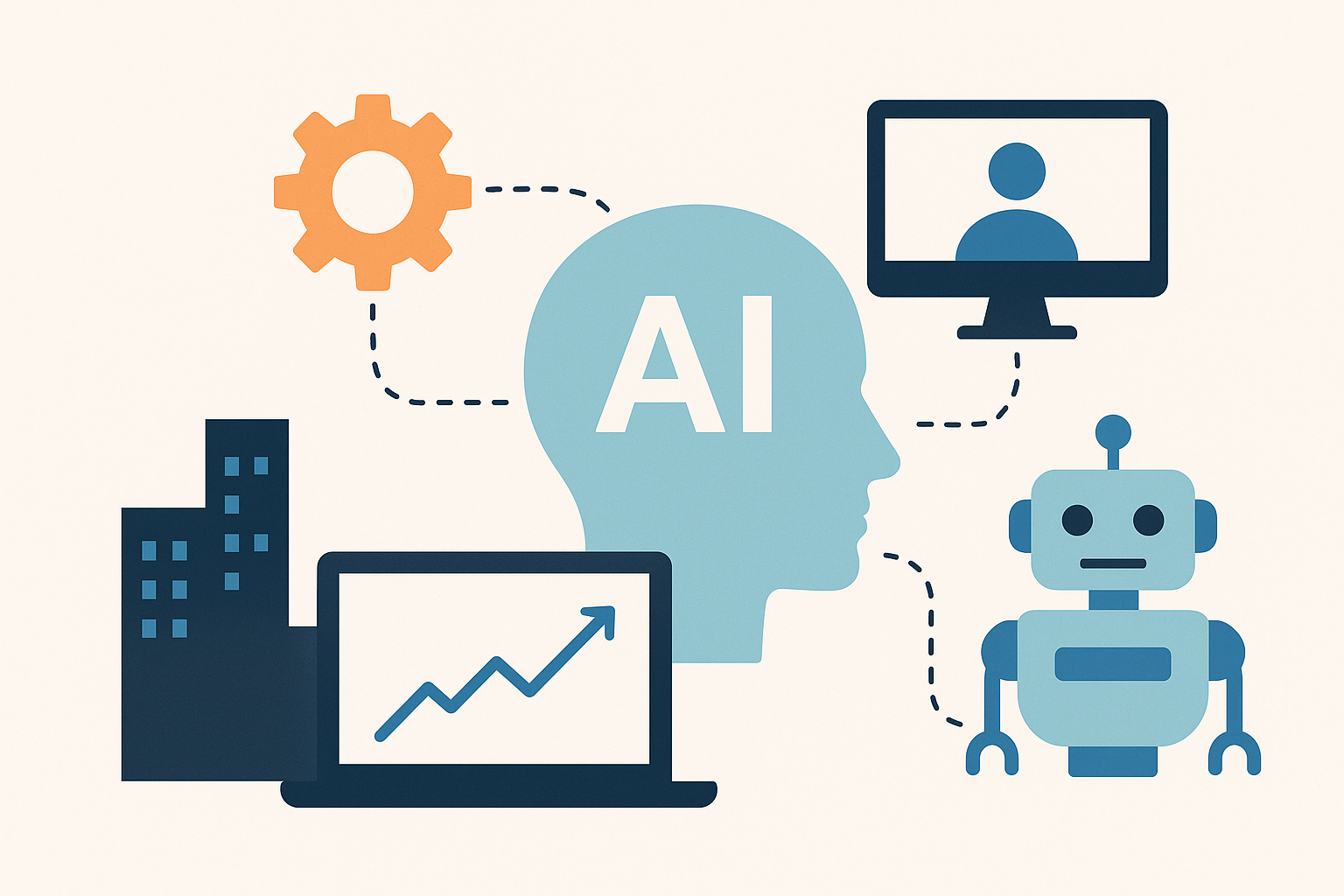
Practical changing landscape for businesses from advancements of artificial intelligence with examples
Focus: This article explains the practical impacts of 2026 AI advancements on businesses - emphasizing recent Google developments - and provides actionable guidance, examples, and risk controls for executives, product leaders, CTOs, and AI strategists. It addresses the "practical changing landscape for businesses from advancements of artificial intelligence with examples" and translates platform capabilities into measurable business outcomes.
What’s new in 2026: Google AI updates that matter to business
In 2026, Google’s AI ecosystem has continued to emphasize large multimodal foundation models, tighter cloud integration for production use, and enterprise-ready governance features. Key themes businesses should track:
- Multimodal foundation models and on-demand fine-tuning: Google’s Gemini family (and its enterprise variants) remain central for text, image, audio, and structured-data understanding. These models are increasingly offered as managed, fine-tunable endpoints through Google Cloud’s Vertex AI, making domain-specialized models faster to deploy (Vertex AI, Google AI).
- Integrated retrieval and vector search: Vector-based retrieval (embeddings + matching engines) is now a standard part of production pipelines for RAG (retrieval-augmented generation), lowering hallucination risk and improving context relevance (Google Cloud generative AI blog).
- Generative AI in productivity tools: Duet-style integrations and AI-assisted workflows in Google Workspace have matured into workplace automation that feeds into enterprise data platforms and audit logs - making adoption easier while creating new governance requirements.
- Edge and on-device inference: Advances in model compression and specialized accelerators (TPUs/GPUs and inference-optimized offerings) enable secure, low-latency AI for retail, manufacturing, and field services.
- Governance, explainability, and tooling: Built-in monitoring, model cards, bias detection, and traceable RAG pipelines are now bundled with enterprise AI stacks to support compliance with frameworks such as the EU AI Act and NIST guidance (NIST AI Risk Management, EU AI Act).
Sources and further reading are listed at the end of this article.
6 key ways AI is changing businesses (with examples, metrics, and risks)
-
1. Personalization at scale - smarter customer journeys
Explanation: Multimodal models + real-time inference enable hyper-personalized recommendations across channels (web, email, voice) with richer context (past interactions, images, and product attributes).
Example: A national retailer implemented a Vertex AI-backed recommendation engine that fuses browsing signals, mobile camera images (user-shared), and inventory status to serve tailored offers in seconds.
Measurable benefits: Typical outcomes include 10-30% lift in conversion rate for targeted segments, 12-25% increase in average order value, and improved customer retention.
Potential risks: Privacy concerns (PII leakage), over-personalization causing customer fatigue, and bias in recommendation leading to uneven exposure for products or sellers.
-
2. Automation of knowledge work - faster, consistent decisions
Explanation: Generative models automate drafting, summarization, and structured-extraction workflows for legal, finance, and HR, allowing skilled knowledge workers to focus on judgment tasks.
Example: A financial services firm used RAG lengthy transcripts, auto-generate litigation drafts, and pre-populate compliance checks. The firm integrated model outputs into Looker dashboards to surface exceptions to human reviewers.
Measurable benefits: 40-60% reduction in drafting time for routine documents, 50% faster response to regulatory inquiries, and lower operational costs per transaction.
Potential risks: Hallucinations in legal or compliance documents; reliance on models without human-in-the-loop review; regulatory exposure if automated outputs are used as final authority.
-
3. Product and R&D acceleration - simulation, design, and co-creation
Explanation: AI enables rapid prototyping: design suggestions from multimodal models, synthetic data generation for training, and physics-informed simulations accelerated by differentiable models.
Example: A manufacturing OEM employed generative design tools to produce lighter parts, using Google Cloud compute and TPU-accelerated training to iterate designs. Synthetic data filled gaps for rare failure modes, improving model robustness.
Measurable benefits: 20-35% reduction in engineering cycle time, reduced physical prototyping costs, and 10-20% improvement in product performance metrics.
Potential risks: IP leakage with third-party model providers; overreliance on synthetic data that doesn't represent edge cases; verification challenges for safety-critical systems.
-
4. Operational efficiency - predictive maintenance and supply chains
Explanation: Time-series models, anomaly detection, and causal inference improve forecasts, reduce downtime, and improve inventories with integrated data platforms.
Example: A logistics operator combined IoT telemetry and video analytics with on-device inference to predict vehicle faults. Maintenance was scheduled proactively, reducing unplanned downtime.
Measurable benefits: 15-40% reduction in unplanned downtime, 10-25% lower spare-parts inventory, and measurable energy savings through optimized routing.
Potential risks: Sensor data quality issues, false positives/negatives in anomaly detection, and supply-chain disruption if models are optimized at the expense of resilience.
-
5. Revenue operations and sales augmentation
Explanation: AI-enhanced opportunity scoring, automated proposal generation, and conversational agents accelerate sales cycles and reduce friction between lead and close.
Example: A B2B SaaS vendor automated proposal generation and used AI to prioritize inbound leads. The sales cycle shortened by predicting likely buyers and pre-populating context-aware proposals.
Measurable benefits: 20-35% reduction in sales cycle length, higher lead-to-opportunity conversion rates, and fewer hours spent on administrative tasks.
Potential risks: Incorrect scoring biases resource allocation, transparency issues with customers, and challenges reconciling AI recommendations with human expertise.
-
6. Risk, compliance, and decision intelligence
Explanation: AI supports risk scoring, regulatory reporting, and scenario analysis - but also creates new categories of model risk and governance requirements.
Example: An insurer deployed model governance pipelines that enforce versioning, datasets audits, and explainability reports before models enter production - reducing regulatory friction and speeding audits.
Measurable benefits: Faster audit cycles, consistent risk scoring, and lower compliance remediation costs; firms report faster model approval times when governance is embedded early.
Potential risks: Regulatory non-compliance if governance is insufficient, adversarial attacks on models, and operational risks from opaque model behavior.
How to adopt: step-by-step implementation for business impact
Phase 0 - Prepare (0-3 months)
- Inventory data assets and establish data quality KPIs (completeness, lineage, freshness).
- Define high-value use cases (revenue, cost, risk reduction) and measurable KPIs.
- Create cross-functional squads (product, engineering, legal, compliance, security).
Phase 1 - Pilot (3-6 months)
- Choose a sandboxed pilot using Google Cloud building blocks: BigQuery for analytics, Vertex AI for model building + fine-tuning, Matching Engine for vector search, Cloud Storage for assets, and Cloud IAM for access control (Vertex AI, BigQuery).
- Implement retrieval-augmented generation to reduce hallucinations: combine embeddings with verified knowledge sources.
- Measure baseline vs. pilot KPIs and perform human-in-the-loop validation.
Phase 2 - Scale (6-18 months)
- Operationalize MLOps: automated CI/CD for models, model cards, drift detection, and rollout strategies (canary, blue/green).
- Integrate logging and observability (Stackdriver/Cloud Monitoring) and enforce access policies with IAM and VPC Service Controls.
- Prepare cost models and governance for production inference (improve instance types, use batching or on-device inference where feasible).
Tooling suggestions (Google Cloud focused)
- Vertex AI - model training, tuning, hosted endpoints, and feature store.
- BigQuery / BigQuery ML - analytics, feature engineering at scale.
- Vertex Matching Engine or managed vector search for RAG pipelines.
- Cloud TPU / GPU and autoscaling for training and high-throughput inference.
- Looker and Data Studio for dashboards and decision intelligence.
Project prioritization checklist
- Impact vs. feasibility matrix: prioritize high-impact, low-data-friction pilots.
- Choose projects with clear KPIs and regulatory clarity.
- Favor projects that deliver reusable data artifacts (embeddings, feature stores).
Change-management tips
- Train and certify staff on AI tooling; embed AI literacy into leadership reviews.
- Run transparent pilots with stakeholder updates and clear escalation paths.
- Use incentives and metrics that reward human + AI collaboration, not replacement only.
Expert opinion: strategic recommendations and governance considerations
Strategy: Treat foundation models as strategic platforms, not point solutions. Invest in data and feature engineering once and reuse across products. Align AI investments to measurable business KPIs and risk appetite.
Policy, ethics, and compliance: Implement a three-tier governance model:
- Preventive controls - data minimization, access controls, vendor risk assessments.
- Detective controls - model-monitoring, performance and fairness metrics, explainability artifacts.
- Corrective controls - rollback plans, incident playbooks, retraining workflows.
Privacy & regulation: Map models to regulatory categories (e.g., high-risk under the EU AI Act). Keep auditable lineage for datasets and model decisions. use differential privacy and on-device approaches for sensitive workloads.
Ethics and bias: Regularly run bias audits, use synthetic tests for edge cases, and document limitations via model cards. In high-stakes decisions, maintain human oversight and clear escalation.
"Successful AI adoption balances speed with governance - rapid pilots plus solid model management." - industry AI lead
Conclusion - summary and next steps for leaders
In 2026, the practical changing landscape for businesses from advancements of artificial intelligence with examples shows a clear pattern: multimodal foundation models, integrated retrieval, and enterprise-grade governance transform customer experience, operations, R&D, and risk management. The path to value runs through disciplined data readiness, focused pilots using platforms like Vertex AI and BigQuery, and mature governance aligned to legal and ethical frameworks.
For organizations planning AI adoption, begin with measurable pilots, instrument models for observability, and embed governance early. For hands-on implementation and strategy, atilab.io offers consulting, implementation, and training tailored to enterprise needs.
Suggested meta description
Practical guide on how 2026 AI advancements - especially Google’s enterprise offerings - are changing businesses, with examples, steps to adopt, and governance advice.