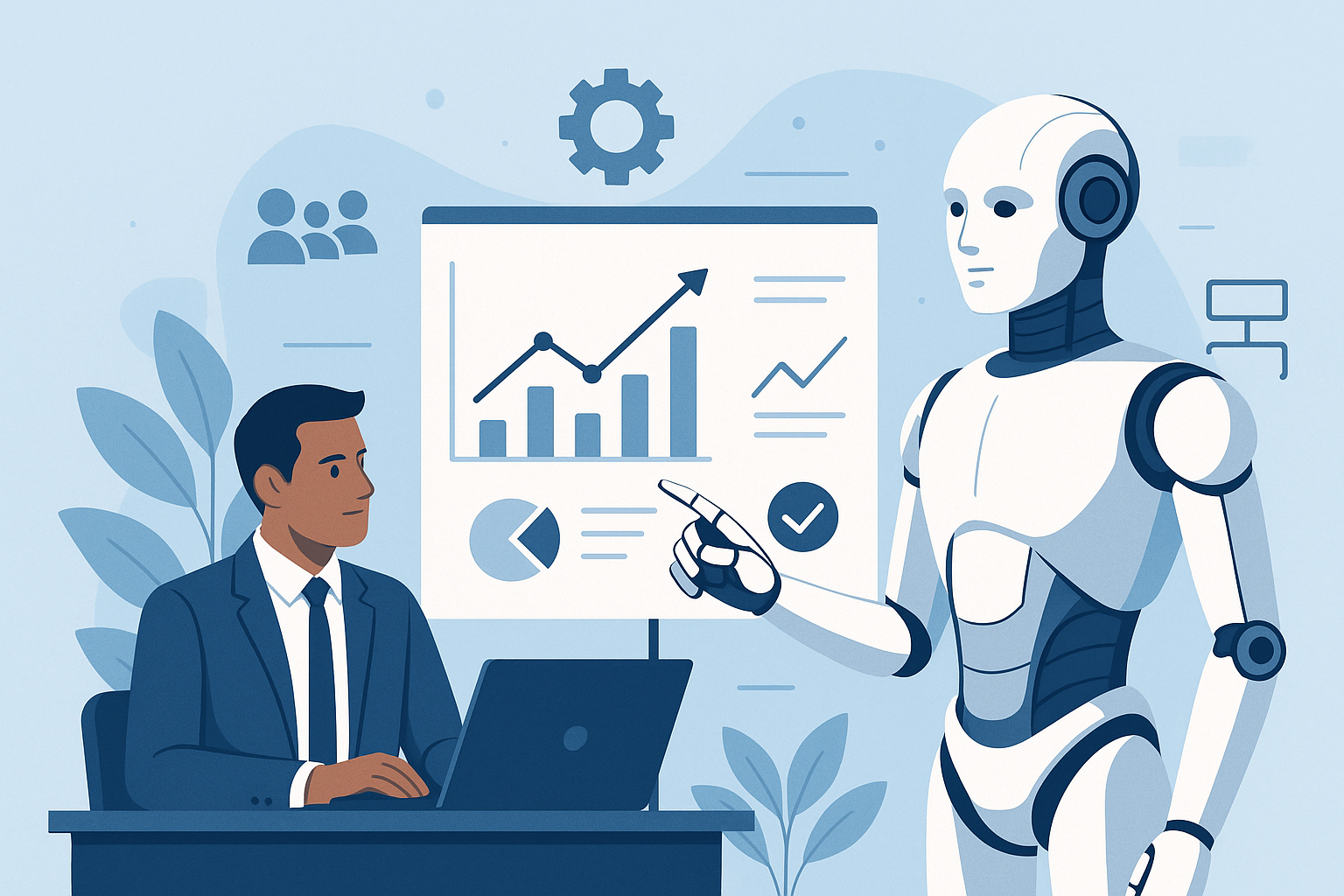
Implementing AI Workforce Strategies for Optimal Performance
Executive summary and objectives
Businesses that adopt AI workforce implementation strategies for optimal performance gain faster decision cycles, higher productivity per employee, and better alignment between technology and business goals. This guide provides a practical, step-by-step tutorial for designing an execution workflow for AI-enabled teams, integrating KPI tracking, and developing a tailored playbook that aligns with corporate objectives. It also reviews the latest Google AI advancements relevant to 2026 and provides an actionable implementation roadmap, governance and ethics considerations, and sample KPIs and templates for immediate adoption.
Objectives:
- Define a repeatable execution workflow for AI-enabled teams.
- Set and track KPIs that measure workforce efficiency and AI impact.
- Build a tailored playbook with roles, governance, and change management templates.
- use 2026 Google AI advancements to improve productivity.
- Deliver a practical roadmap with milestones, risks, and continuous improvement practices.
Step-by-step: Designing an execution workflow for AI-enabled teams
A solid execution workflow turns AI experiments into scalable, measurable capabilities. Use this 6-step workflow template to operationalize AI across teams.
1. Opportunity identification and prioritization
- Map processes by value and pain: revenue impact, cost, customer experience, compliance risk.
- Use a scoring matrix (impact, feasibility, data availability) to prioritize pilots.
2. Hypothesis and success criteria
- Define a clear hypothesis: what will change and how it'll be measured.
- Agree on success thresholds tied to KPIs (see KPI section).
3. Data readiness and tooling
- Inventory data sources, quality, access permissions, and latency.
- Choose tools for data pipeline orchestration, model hosting, and observability.
4. Build, validate, and pilot
- Adopt short sprints (2-4 weeks) with clear deliverables: prototype → sandbox → pilot.
- Validate with representative users and run A/B or shadow deployments where feasible.
5. Scale and integrate
- Move from pilot to production with CI/CD for models, retraining strategies, and runtime monitoring.
- Automate handoffs between AI outputs and human workflows-define triggers and fallbacks.
6. Operate and iterate
- Establish incident response for model drift, data issues, and user feedback loops.
- Embed continuous improvement cycles tied to KPI reviews and change management.
Step-by-step: Integrating KPI selection and tracking
KPI selection determines whether your AI workforce initiatives actually deliver improved performance. Align KPIs to corporate objectives and ensure they're observable, attributable, and actionable.
Core KPI categories and sample metrics
- Productivity: Output per FTE, tasks automated per week, time saved per task (hours).
- Quality: Error rate reduction (%), rework rate, customer satisfaction (CSAT) delta.
- Speed: Cycle time reduction, mean time to decision, throughput per hour.
- Adoption: Active users, feature usage, task completion rate for AI-assisted workflows.
- Financial: Cost per transaction, ROI, incremental revenue attributable to AI.
- Risk & compliance: False positives/negatives, incident frequency, audit coverage.
Designing dashboards and data sources
- Dashboards should combine operational telemetry (logs, latency, error rates), business metrics (sales, churn), and people metrics (time-to-complete, satisfaction).
- Typical data sources: CRM, ERP, HRIS, observability platforms, model logs, and feedback forms.
- Visualization best practices: one KPI per card, trend lines, cohort comparisons, and annotation of releases/changes.
Feedback loops and attribution
- Implement closed-loop feedback: users can flag incorrect outputs and those flags feed model improvement pipelines.
- Use experiment frameworks (A/B testing, canary releases) to attribute improvements to AI interventions vs. other factors.
Step-by-step: Developing a tailored playbook aligned with corporate objectives
A playbook operationalizes your AI workforce strategy into roles, governance, templates, and change management practices. Below is a compact playbook template you can adapt.
Playbook essentials
- Purpose & scope: Business outcomes targeted (e.g., reduce claims processing time by 40%).
- Roles & responsibilities:
- AI Product Owner - defines value and prioritizes features.
- Data Owner - ensures data access and quality.
- Model Ops Engineer - maintains CI/CD, deployment, monitoring.
- Business Champion - aligns stakeholders and drives adoption.
- Ethics & Compliance Lead - oversees risk, bias, and regulatory adherence.
- Governance model: Approval gates, data access rules, model risk classification, and audit cadence.
- Change management: Training plans, internal communications, role redefinitions, performance review adjustments.
- Templates: Project brief, success criteria checklist, risk register, retrospective template.
Sample playbook checklist
- Document business case and KPI alignment.
- Confirm data sources and access permissions.
- Classify model risk and assign controls.
- Define rollout plan with training and support materials.
- Set monitoring thresholds and escalation paths.
Review: Google AI trends and advancements relevant to 2026
Google continues to shape enterprise AI with foundational model services, tooling, and AI infrastructure. Below are 4-6 specific Google AI trends in 2026 and recommended usage patterns to improve workforce efficiency and productivity.
1. Foundation models as composable services
Google’s modular foundation models (text, vision, multimodal) are available via managed APIs. Recommended usage: integrate foundation models for knowledge summarization, automated drafting, or intelligent routing-use lightweight fine-tuning or instruction tuning to align outputs to corporate tone and policies.
2. On-prem + hybrid model hosting (Vertex AI + Confidential Computing)
Hybrid options let businesses run models close to sensitive data. Recommended usage: keep PII-intensive inference on-premises while use cloud models for non-sensitive tasks, reducing latency and meeting compliance demands.
3. Enhanced retrieval-augmented generation (RAG) and enterprise search
Google’s advances in vector databases and RAG pipelines enable accurate, source-attributable answers. Recommended usage: deploy RAG for knowledge worker assistants, customer support summarization, and policy retrieval-log source attributions to support auditability.
4. Responsible AI tooling and model explainability
Built-in bias detection, fairness reports, and explainability tools simplify governance. Recommended usage: embed explainability checks into CI/CD and require fairness/signoff for high-risk models before production rollout.
5. AutoML and low-code integration for citizen developers
Google’s low-code platforms democratize model development. Recommended usage: permit trained business users to prototype using guardrails; maintain central MLOps oversight for production promotion.
6. Edge AI improvements for distributed workforce tools
Lighter models and optimized runtimes enable offline or edge inference for field teams. Recommended usage: employ edge AI for mobile workflows, real-time decision support, or sensor-based automation to improve frontline productivity.
Implementation guidance: roadmap, milestones, risks, and continuous improvement
Below is a practical 12-month roadmap, key milestones, common risks with mitigations, and a measurement cadence to sustain gains.
12-month roadmap (high level)
- Month 0-1: Strategy alignment, executive sponsorship, and KPI definition.
- Month 2-3: Data readiness assessment, tooling selection (MLOps, dashboards).
- Month 4-6: Pilot development and controlled experiments with prioritized use cases.
- Month 7-9: Scale production deployments, training, and adoption programs.
- Month 10-12: improve operations, implement governance audits, and iterate on ROI targets.
Milestones and success checkpoints
- Signed executive sponsor and defined KPIs.
- First pilot delivering measurable KPI uplift (e.g., 15% cycle time reduction).
- Operational monitoring in place with alerting and incident playbooks.
- Documented playbook, role assignments, and compliance signoffs.
Risks and ethics considerations
- Data privacy: Enforce least privilege and encryption in transit and at rest.
- Bias and fairness: Run fairness audits, use representative datasets, and require human oversight on high-impact decisions.
- Over-reliance on automation: Define decision thresholds where humans must review output.
- Change resistance: Invest in training, incentives, and transparent communication of benefits.
Measurement and continuous improvement
- Weekly operational metrics, monthly KPI reviews, quarterly business impact reviews.
- Retrospectives after every sprint and post-release audits for model performance and business outcomes.
- Continuous learning loop: user feedback → data labeling → retraining schedule → redeploy.
Sample KPI dashboard elements
- Top-line: ROI %, cost savings, revenue impact.
- Operational: latency, error rate, uptime, tasks automated.
- People: adoption rate, time saved per role, satisfaction scores.
- Risk: number of incidents, fairness metrics, compliance status.
Case examples, next steps, and resources/checklists
Two brief hypotheticals
Example A - Claims Processing (Insurance): A mid-sized insurer uses RAG-enabled assistants to pre-fill claim forms and flag anomalies. Result: 50% reduction in manual intake time, 20% faster payouts, and a 12% reduction in error-related rework. KPIs used: time-to-first-decision, claim rework rate, customer NPS.
Example B - Sales Enablement (Technology Firm): Sales reps use an AI co-pilot past interactions and propose personalized outreach. Result: pipeline velocity improves; win rates increase by 8%. KPIs used: conversion rate, average deal size, time-to-close.
Next steps checklist
- Obtain executive sponsor and finalize target KPIs.
- Run a 6-8 week pilot on a high-impact, low-risk process.
- Implement monitoring, feedback loops, and a governance review.
- Document playbook and scale with staged rollout.
Practical templates (copy & adapt)
- Project brief: objective, KPI target, data sources, success threshold, timeline.
- Risk register: risk, likelihood, impact, mitigation, owner.
- Retrospective template: what worked, what didn’t, action items, owners, deadlines.
- KPI sample:
- Time saved per task (hrs): Baseline 2.5 → Target 1.0
- Tasks automated/week: Baseline 0 → Target 300
- CSAT delta: Baseline 72 → Target 80
- Model drift incidents/month: Target < 2
"AI strategy succeeds when people, process, and technology are tightly aligned to measurable business outcomes."
Conclusion
Implementing AI workforce implementation strategies for optimal performance is a practical, measurable transformation-not a one-time project. By designing a clear execution workflow, integrating rigorous KPI tracking, and building a tailored playbook that aligns with corporate objectives, organizations can safely scale AI to augment human work. use 2026 Google AI advancements-foundation models, hybrid hosting, RAG, explainability tools, low-code AutoML, and edge AI-accelerates outcomes while maintaining governance and ethical controls. Start small, measure continuously, and iterate the playbook as you learn.