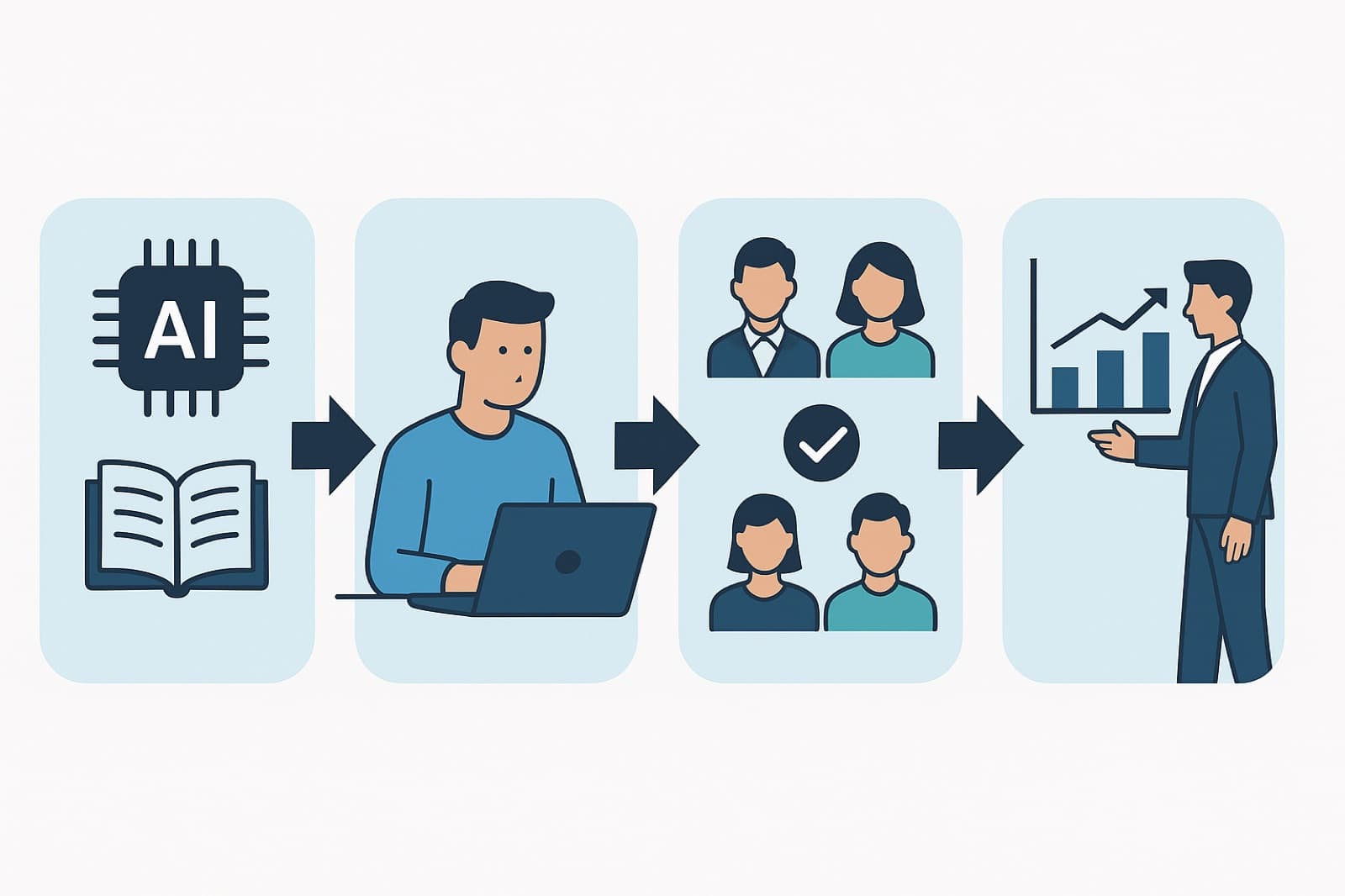
Step-by-step artificial intelligence workforce for companies with examples - Enterprise playbook for CTOs and operations leaders
Audience: Business leaders, CTOs, AI/ML managers and operations leads aiming to build or scale an AI-capable workforce.
This post delivers a pragmatic, role-based step-by-step artificial intelligence workforce for companies with examples, timelines, and clear responsibilities you can apply this quarter. It emphasizes the latest Google developments (2026) and concrete actions to integrate AI into operations, product, and customer workflows.
What’s new from Google (2026) - top 3 developments and enterprise implications
By 2026 Google has pushed enterprise-focused capabilities that materially change how companies staff and operate AI teams. The three developments below directly affect how you build a step-by-step artificial intelligence workforce for companies with examples and measurable outcomes.
1. Enterprise-grade multimodal models and assistant APIs (Gemini family advances)
Google's multimodal LLMs now support advanced reasoning, code generation, and high-throughput embeddings with fine-tuning and instruction-tuning options designed for enterprise contexts. Implication: Teams can rely on hosted model APIs for core capabilities while focusing internal hires on prompt engineering, evaluation, and domain adaptation.
2. Vertex AI as a full-stack MLOps and model governance platform
Vertex AI expanded automated pipelines, drift detection, model lineage, and a marketplace for third-party models and components. Implication: Firms should standardize MLOps workflows around cloud-managed tools, reducing bespoke infra and allowing workforce roles to shift from infra-maintenance to feature development and monitoring.
3. Privacy and secure inference tooling (on-device models and privacy-preserving inference)
Google introduced stronger support for on-device models, federated learning primitives, and homomorphic-encryption-ready inference paths. Implication: Companies in regulated industries can deploy generative or recommendation models with reduced data exfiltration risk-changing staffing needs toward privacy engineers and compliance liaisons.
8-step implementation roadmap: action, timeline, and responsibilities
Below is an operational roadmap you can adopt as the backbone of a step-by-step artificial intelligence workforce for companies with examples. Each step includes clear actions, an estimated timeline, and suggested owners.
-
1. Assessment - baseline capabilities and opportunity mapping (2-4 weeks)
Actions:
- Inventory data assets, current models, tools, and skills.
- Map 10-15 business processes where AI can deliver >=10% improvement in cost, time, or customer satisfaction.
- Run a rapid feasibility matrix (impact vs. effort).
Responsibilities: Product lead + Data lead + Business owner. Deliverable: Opportunity matrix and prioritized 90-day pilots.
-
2. Strategy - define mission, success metrics, and funding (1-2 weeks)
Actions:
- Set AI mission and three-year objectives (e.g., reduce support time by 30%, automate 40% of data labeling).
- Define unique metrics: “Automation Yield” (tasks automated per FTE) and “Model Value Retention” (post-deploy accuracy vs. baseline).
- Secure a pilot budget and identify stakeholders.
Responsibilities: CIO/CTO + Finance + Product. Deliverable: AI strategy one-pager and KPIs dashboard template.
-
3. Roles - design the AI workforce and role-based playbooks (2-3 weeks)
Actions:
- Define roles and playbooks: AI Product Manager, ML Engineer, Prompt Engineer, Data Steward, MLOps Engineer, Privacy Engineer, Domain SMEs.
- Create role-based onboarding checklists and 30/60/90 day goals.
- Identify facilitator roles for cross-functional squads (business + data).
Responsibilities: HR + AI Chapter Lead. Deliverable: Role catalog and playbooks for each role (see playbook section below).
-
4. Hiring & Upskilling - blended approach (ongoing, initial sprint 8-12 weeks)
Actions:
- Hire selectively for 2 must-have senior roles (ML Architect, MLOps Lead); backfill juniors via internal upskilling.
- Launch internal bootcamps: prompt engineering, model evaluation, and secure inference practices.
- Use apprenticeship hires embedded in product teams for practical learning.
Responsibilities: Talent Acquisition + L&D. Deliverable: Training curriculum and hiring scorecards.
-
5. Data & Infrastructure - secure, catalog, and pipeline (4-12 weeks)
Actions:
- Implement a data catalog and access controls; tag sensitive data for compliance.
- Standardize feature stores and embed Vector DBs for retrieval-augmented generation (RAG).
- Choose cloud-managed MLOps (e.g., Vertex AI) or private alternatives; set up CI/CD for data and models.
Responsibilities: Data Engineering + Security. Deliverable: Production data pipelines, data catalog, and secure access patterns.
-
6. Model selection & vendor choices - pragmatic hybrid strategy (2-6 weeks per pilot)
Actions:
- Adopt a hybrid model sourcing strategy: hosted APIs for general capabilities, fine-tune or deploy private models for sensitive domains.
- Run vendor scorecards evaluating latency, cost per 1M tokens, privacy options (FHE, on-device), and SLAs.
- Plan for fallbacks and prompt/versioning policies.
Responsibilities: ML Architect + Procurement. Deliverable: Approved vendor list and integration playbook.
-
7. Integration & MLOps - productionize with observability (4-12 weeks)
Actions:
- Implement model CI/CD pipelines, automated testing, canary releases, and rollback strategies.
- Instrument observability: prediction drift, input distribution alerts, latency and cost-per-call dashboards.
- Embed human-in-the-loop workflows for high-risk outputs.
Responsibilities: MLOps Engineers + Platform Team. Deliverable: Production deployment pipeline and monitoring dashboards.
-
8. Governance & KPIs - safety, compliance, and continuous improvement (ongoing)
Actions:
- Define governance guardrails: acceptable use policy, escalation paths, model cards and datasheets.
- Track KPIs: Automation Yield, Model Value Retention, True Positive/False Positive shift rates, Time-to-Rollback.
- Run quarterly model audits and ethical reviews; maintain a risk register.
Responsibilities: Risk & Compliance + AI Ethics Board. Deliverable: Governance playbook, regular audit cadence, and KPI dashboard.
Hands-on tutorial / playbook: checklists, tools, templates, and sample timeline
This single playbook converts the roadmap into day-to-day tasks for three roles: AI Product Manager, MLOps Engineer, and Business Operations Lead.
Role-based quick playbooks (30/60/90 day focus)
- AI Product Manager (30): Run discovery interviews, define success metrics, prioritize pilot backlog. (60): Finalize data contracts and stakeholder alignment. (90): Measure pilot ROI and iterate.
- MLOps Engineer (30): Stand up dev environment, create CI for model training. (60): Deploy first canary with monitoring. (90): Automate retraining pipeline.
- Business Operations Lead (30): Map SOPs and data sources. (60): Implement KPI dashboard. (90): Lead change management and role transitions.
Checklist: Minimum viable AI deployment
- Data catalog entry for training and production datasets
- Data access policy and consent logging
- Model card and basic metrics (accuracy, latency, cost)
- Canary deployment plan and rollback trigger
- Human-in-loop escalation for edge-case outputs
Recommended tools (practical)
- Cloud MLOps: Vertex AI (Google), alternatives: Azure ML, AWS SageMaker
- Vector DBs & RAG: Pinecone, Weaviate, or managed Vertex embeddings
- Observability: Prometheus/Grafana, Sentry, Hugging Face or custom drift monitors
- Data catalog: DataHub, Amundsen, Google Data Catalog
- Collaboration & experiments: MLflow, Weights & Biases
Templates (copy-and-adapt)
- Pilot brief: Objective | Success metric | Data sources | Risks | Owner | Timeline
- Model card template: Purpose | Data provenance | Evaluation metrics | Limitations | Contact
- Post-mortem: Trigger | Impact | Root cause | Fix | Prevention
Sample 12-week implementation timeline (pilot to production-ready)
- Weeks 1-2: Assessment and pilot selection; stakeholder alignment.
- Weeks 3-4: Data ingestion, cataloging, and initial model selection.
- Weeks 5-6: Prototype model + prompt iterations; evaluate against acceptance criteria.
- Weeks 7-8: MLOps pipeline and canary deployment; integrate monitoring.
- Weeks 9-10: Human-in-loop validation, performance tuning, cost optimization.
- Weeks 11-12: Production rollout, KPI baseline, and roadmap for scale.
Five real-world examples & mini case studies (industry, outcome, ROI, lessons learned)
1. Retail - automated customer support summarization
Outcome: Reduced average handle time by 28% and first-call resolution improved 12%. ROI: Payback in 9 months through labor savings and CSAT gains. Lesson: Focus on RAG with product catalog embeddings and continuous feedback to prevent hallucinations.
2. Financial services - compliance-aware document ingestion
Outcome: Reduced manual compliance review hours by 40% and improved anomaly detection recall. ROI: 18% operational cost reduction within year one. Lesson: Invest early in PII tagging and privacy-preserving inference to gain regulator confidence.
3. Healthcare - clinical decision support assistant
Outcome: Clinicians reported 15% faster chart reviews; trial measured zero adverse events linked to AI recommendations. ROI: Hard to measure immediately but improved throughput increased revenue per clinician. Lesson: Heavy emphasis on human-in-the-loop and conservative release strategy.
4. Manufacturing - predictive maintenance optimization
Outcome: Downtime dropped 22% and spare-parts inventory reduced 9%. ROI: Payback in 7 months on sensor integration and analytics. Lesson: Combining time-series forecasting models with rule-based suppression reduced false alerts.
5. Media/Publishing - personalized content recommendations
Outcome: Engagement (time on site) rose 30% and subscription conversion increased 6%. ROI: Subscription revenue increase covered model and infra costs within 6 months. Lesson: Track long-term retention uplift (not only click-through) as the primary metric.
Practical next steps, measurement framework, and SEO-ready conclusion
Practical next steps (in the next 30 days)
- Run the assessment checklist and select one pilot aligned to high-impact, low-risk criteria.
- Appoint an AI Product Manager and MLOps lead with clear 30/60/90 goals.
- Set up a minimum monitoring dashboard and a model card template for the pilot.
Measurement framework - what to track
Combine business and model metrics for a complete view:
- Business KPIs: Automation Yield, Cost per Outcome, Customer Satisfaction (CSAT), Revenue Lift
- Model KPIs: Accuracy/Precision/Recall, Latency, Cost per Inference, Model Value Retention
- Operational KPIs: Time-to-deploy, Mean Time to Detect Drift, Mean Time to Rollback
Internal link suggestions and on-page SEO elements
Suggested internal links for atilab.io content structure:
- /services/ai-strategy - AI strategy and assessment offerings
- /resources/ai-playbooks - Role-based playbooks and templates
- /case-studies - Industry case studies and ROI examples
Schema ideas to include on the page
Embed JSON‑LD for:
- Article (title, description, author, datePublished)
- HowTo (steps of the 8-step roadmap for discoverability)
- Organization schema for atilab.io
Unique metrics and role-based playbooks reduce ambiguity and accelerate adoption - measure both human and model productivity.
Conclusion: This playbook presents a practical, step-by-step artificial intelligence workforce for companies with examples and role-based checklists designed for immediate implementation. Use the 8-step roadmap, the hands-on playbook, and the measurement framework to reliably move pilots to production while minimizing risk. Consider trying this approach and adapt the role playbooks to your company scale and regulatory environment.