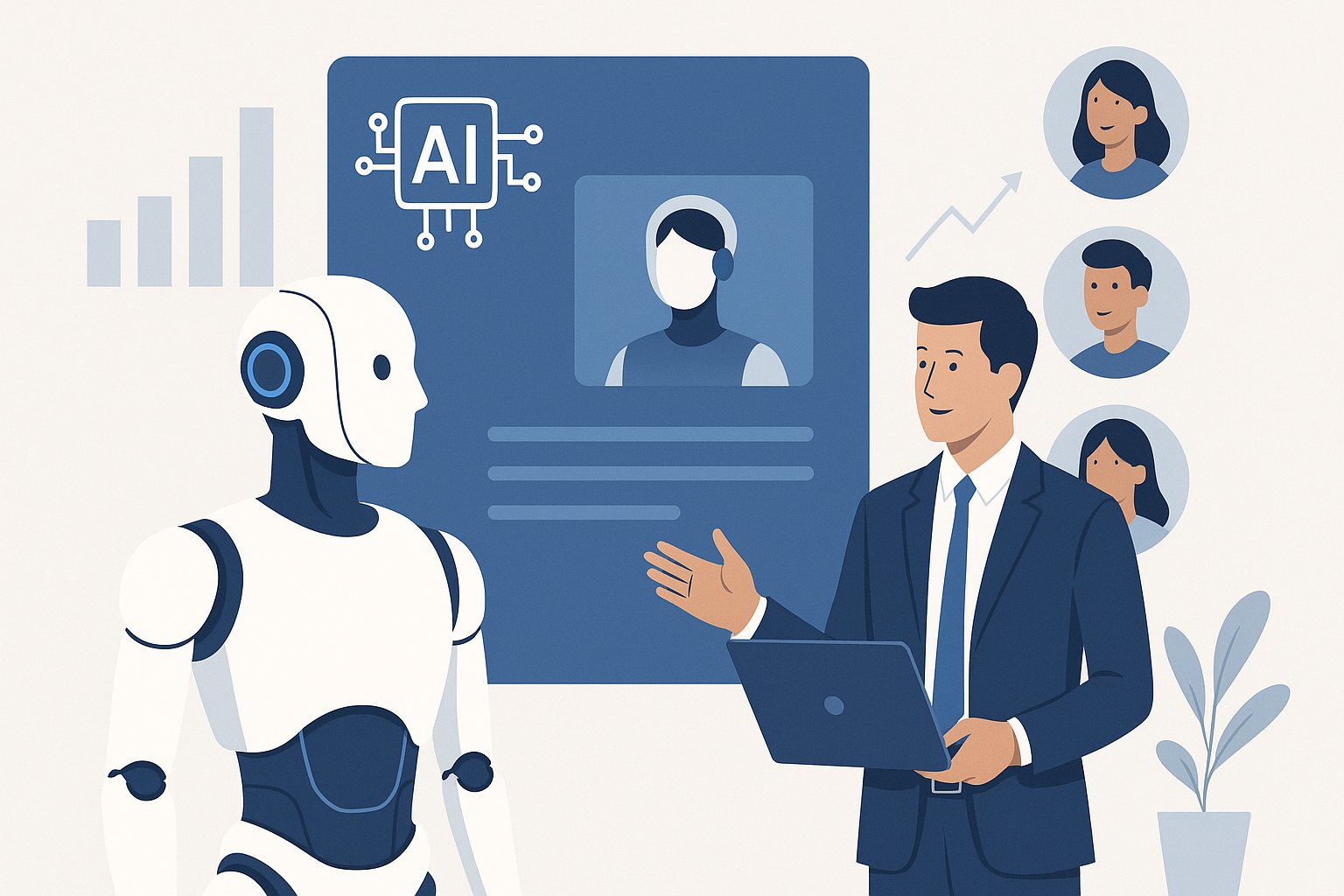
Building the Best Artificial Intelligence Workforce for Companies with Examples - A Tactical 2026 Playbook
Hook: By 2026, the competitive edge will belong to companies that pair clear business strategy with a tightly engineered AI workforce-teams that deliver predictable ROI, auditable governance, and rapid productization of models.
Value proposition: This post gives business leaders a tactical, example-driven blueprint to assemble and scale the best artificial intelligence workforce for companies with examples, integrating the latest Google AI advancements into production-ready workflows.
what's an "AI workforce" and why it matters in 2026
An AI workforce is the cross-functional mix of people, processes, and vendor relationships that together design, build, deploy, monitor, and govern AI-driven products. It spans technical roles (ML engineers, data engineers), product & operational roles (AI product managers, MLOps), and governance roles (AI ethicists, legal/compliance). In 2026, the AI workforce matters because enterprises must move from experimentation to repeatable, governed, and cost-effective production use-where models are business assets, not one-off projects.
Key shifts that make workforce design urgent in 2026:
- Large multimodal models (Gemini/PaLM-class) require specialized integration and cost management.
- Stricter regulation and customer expectations demand solid model governance and audit trails.
- Cloud-managed MLOps (e.g., Vertex AI) provide rapid deployment but require new skills to extract business value.
Ranked: 7 best AI workforce configurations and roles (with company examples)
Below are the seven most effective workforce configurations, ranked by the combination of ROI potential, speed-to-market, and governability. Each entry includes a concise company example or short case study you can emulate.
-
1. In-house ML Engineers (Core model developers)
Role: Build and fine-tune models, implement custom architectures, own model performance.
Example/case: A mid-sized fintech built an internal ML team of three senior ML engineers to fine-tune a PaLM-class model on proprietary transaction data; within six months they reduced false positive fraud alerts by 45%, saving $1.2M annually. Key tactic: prioritize model reproducibility (containerized training + experiment tracking).
-
2. Data Engineers & Feature Teams
Role: Provide production-quality data pipelines, feature stores, and lineage.
Example/case: A retail chain assigned a feature engineering squad to build a Vertex Feature Store pipeline feeding both forecasting models and recommender systems-improving availability of production features from weekly to near-real-time and increasing conversion rates by 8%.
-
3. MLOps Practitioners (CI/CD, monitoring, cost ops)
Role: Automate model build/deploy/monitor, manage infra cost, implement rollback and drift detection.
Example/case: A SaaS provider centralized model deployment with Vertex AI Pipelines and automated model validation tests. They cut time-to-deploy from 4 weeks to 3 days and eliminated 70% of manual release incidents.
-
4. AI Product Managers & Domain Translators
Role: Translate business outcomes to measurable ML objectives, shape experiments, and prioritize backlogs.
Example/case: An insurance firm added AI PMs embedded with underwriting teams to translate a 12-month innovation roadmap into prioritized pilots. Using clear KPIs (loss ratio impact, manual effort reduction), they achieved a 20% decrease in manual review time from a single pilot.
-
5. Prompt Engineers & LLM Integration Specialists
Role: Design LLM prompts, chains, retrieval-augmented-generation (RAG) flows, and guardrails for generative use-cases.
Example/case: An enterprise support org employed prompt engineers to rework responses for a Gemini-class LLM via RAG with internal KB-reducing average resolution time 30% and increasing CSAT by 12 points. Key practice: versioned prompt testing and A/Bing in production.
-
6. AI Ethicists & Compliance Officers
Role: Operationalize policy, model risk assessments, and fairness / privacy checks to meet regulators and customers.
Example/case: A healthcare provider embedded an AI compliance lead into each model review cycle; that role ensured data provenance, created a mitigation plan for bias alerts, and reduced regulatory review time by 50% during audits.
-
7. Strategic Vendor Partnerships & Hybrid Teams
Role: Combine cloud providers, boutique AI consultancies, and in-house teams to fill gaps quickly.
Example/case: A logistics company used a strategic partnership with a specialized ML firm to bootstrap computer vision capabilities for warehouse automation while training internal teams-resulting in a 9-month handover plan and continued 15% efficiency gains after vendor exit.
How to pick: Most enterprises achieve best results with a combined model: small core of in-house ML + strong MLOps + embedded AI PMs + vendor partnerships to accelerate specialist work (vision, speech, LLM ops).
A tactical 5-step playbook to build or transform your AI workforce
This playbook is designed for leaders ready to move from pilots to production without bloated hiring or governance gaps.
-
Step 1 - Assess needs, prioritize ROI, and map capability gaps
Actionable tasks: run a 2-week AI capability audit across product lines, estimate expected value (revenue uplift, cost reduction), and score projects by ease-of-adoption and regulatory risk. Output: prioritized pipeline of 3 projects for a 6-12 month roadmap.
-
Step 2 - Hire/reskill to the critical 30%
Actionable tasks: hire or reskill for roles that change the needle-1 senior ML engineer, 1 MLOps engineer, 1 AI PM, 1 prompt engineer. Use 12-week apprenticeships where vendors shadow internal hires to transfer knowledge.
-
Step 3 - Set up MLOps, reproducible pipelines, and cost controls
Actionable tasks: deploy managed pipelines (Vertex AI Pipelines), feature store, experiment tracking (MLflow or Vertex Experiments), model registry, and automated cost alerts for expensive LLM calls. Enforce infrastructure as code and pre-deployment tests.
-
Step 4 - Pilot deployment with tight KPIs and rollback plans
Actionable tasks: run an initial pilot for 8-12 weeks with A/B testing, predefined acceptance criteria (precision/recall, business metric lift), and automated rollback triggers. Capture telemetry for model explainability and compliance.
-
Step 5 - Scale, govern, and institutionalize
Actionable tasks: create a model governance committee, schedule quarterly model reviews, implement drift detection, cost optimization playbooks, and a continuous training cadence. Define role-based responsibilities for incident response and audit trails.
Practical tip: Treat each role like a product line-measure time to value and retention of institutional knowledge after vendor engagements end.
Google AI advancements relevant to 2026 - what leaders must adopt now
Google's AI ecosystem has shipped features that materially change enterprise adoption strategy. Below are the most impactful advancements and exactly how to translate them into enterprise actions.
Vertex AI improvements (managed MLOps, model governance, infra)
Advancement summary: Vertex AI now provides tighter integration of model registries, automated model lineage, managed private model hosting for large models, lower-latency served LLM endpoints, and cost-aware autoscaling features.
Actionable integrations:
- Use Vertex Model Registry to enforce model versioning and approvals; require registry sign-off for production promotion.
- Enable managed private model hosting for proprietary fine-tuned models to reduce data exfiltration risk and improve latency.
- Configure autoscaling with cost caps and preemptible training to control LLM fine-tuning costs.
Gemini / PaLM-class models and multimodal tooling
Advancement summary: Gemini/PaLM-class models provide multimodal understanding, improved instruction following, and built-in retrieval augmentation primitives-making RAG deployments faster and more accurate.
Actionable integrations:
- Prototype RAG for customer support using a managed vector store and internal KB; measure resolution time and hallucination rate vs. baseline.
- use multimodal capabilities for product QA: combine image + text inputs to automate defect triage in manufacturing imagery.
- Use instruction-tuning and safety filters provided by Google to reduce hallucinations; integrate prompt/version testing into CI for prompt changes.
Tooling, accelerators, and model governance features
Advancement summary: Built-in governance features (lineage, drift detection, explainability tools), accelerator libraries, and templates for common verticals (finance, health, retail) speed deployments.
Actionable integrations:
- Adopt Google’s prebuilt templates to accelerate compliance-heavy pilots, then swap in proprietary datasets incrementally.
- Operationalize explainability exports as part of the deployment checklist to meet audit requirements.
- Enable continuous drift detection and set notification thresholds to trigger retraining pipelines automatically.
Suggested readings and references: Google Cloud AI & Vertex AI documentation provide concrete implementation patterns and governance capabilities; review them when designing your technical plan.
Hands-on tutorial & checklist: immediate actions, tools to try, pilot scope, and metrics
The following checklist is a condensed, action-focused runbook for your first 90-day pilot.
Tools to try in the first 30-90 days
- Vertex AI (Model Registry, Pipelines, Feature Store, Model Monitoring)
- BigQuery for analytic features and scorable datasets
- Managed vector stores (Vertex Matching Engine or supported alternatives) for retrieval augmentation
- Experiment tracking: Vertex Experiments or MLflow
- Prompt testing frameworks and shadow deployments for LLMs
Pilot scope template (8-12 week)
- Week 0-2: Capability audit, data access approvals, and pilot definition (clear KPI baseline).
- Week 3-6: Build minimal viable pipeline (data ingestion, feature store, model prototype or RAG flow). Include automated tests for data quality.
- Week 7-9: Shadow deploy with live telemetry, A/B measurement, and safety testing (PII checks, hallucination rate).
- Week 10-12: Evaluate results against KPIs, document governance artifacts, and create a 3-6 month scale plan.
Key metrics to track (business + technical)
- Business: incremental revenue, cost savings, customer satisfaction (CSAT), time-to-resolution
- Technical: model latency, token/compute cost per request, precision/recall or BLEU/ROUGE where applicable
- Governance: model drift rate, explainability coverage, data lineage completeness
Quick wins that deliver early ROI
- Implement RAG for top 5 FAQs to reduce support load and measure 30-day reduction in live agent time.
- Automate a manual data validation step to cut preprocessing time by 50% and improve model freshness.
- Move one high-impact model to managed hosting to reduce infra ops by >60% and shrink incident MTTR.
Implementation timelines, budget considerations, and a governance & ethics checklist
Practical implementation timelines
Suggested conservative timeline for enterprise adoption:
- 0-3 months: Audit, pilot selection, initial hires/reskilling
- 3-9 months: Execute 1-2 pilots, deploy MLOps baseline, operationalize monitoring
- 9-18 months: Scale 3+ production models, establish governance committee, internal capability takeover from vendors
Budget considerations (ballpark)
Costs vary by scale; use these ranges to start conversations:
- People (first year): $750k-$2M for a lean core team (salaries + reskilling)
- Cloud infra and managed services: $50k-$500k annually depending on LLM usage and data processing needs
- Vendor acceleration: one-off $100k-$500k for specialist pilots and knowledge transfer
Cost control tactics: use preemptible training, token budgets, caching layers for LLM responses, and quota-based spend controls.
Governance & ethics checklist (quick)
- Define ownership: who approves model promotion and incident response?
- Data lineage: can you trace training data to source and consent?
- Bias/fairness testing: do you've automated fairness audits and mitigation plan?
- Privacy & security: are models deployed in private hosting where needed and encrypted at rest/in transit?
- Explainability: can you produce an explanation for business-impacting predictions within SLA?
- Logging & audits: is model behavior and access logged for at least required regulatory window?
Conclusion - next steps for business leaders
Assembling the best artificial intelligence workforce for companies with examples means combining a small, strategic in-house team with disciplined MLOps, embedded AI product leadership, and selective vendor partnerships. Use Vertex AI’s governance and hosting features, Gemini/PaLM-class capabilities for multimodal and RAG use-cases, and the practical 5-step playbook above to move from experiments to reproducible, auditable production value.
Practical next step: Run a 2-week capability audit and identify one high-impact pilot (8-12 weeks) you can measure end-to-end-data, model, deployment, governance.
Consider scheduling a consultation with your internal stakeholders to apply this playbook to your organization's highest-value use-cases or request a whitepaper summarizing your 90-day pilot plan.