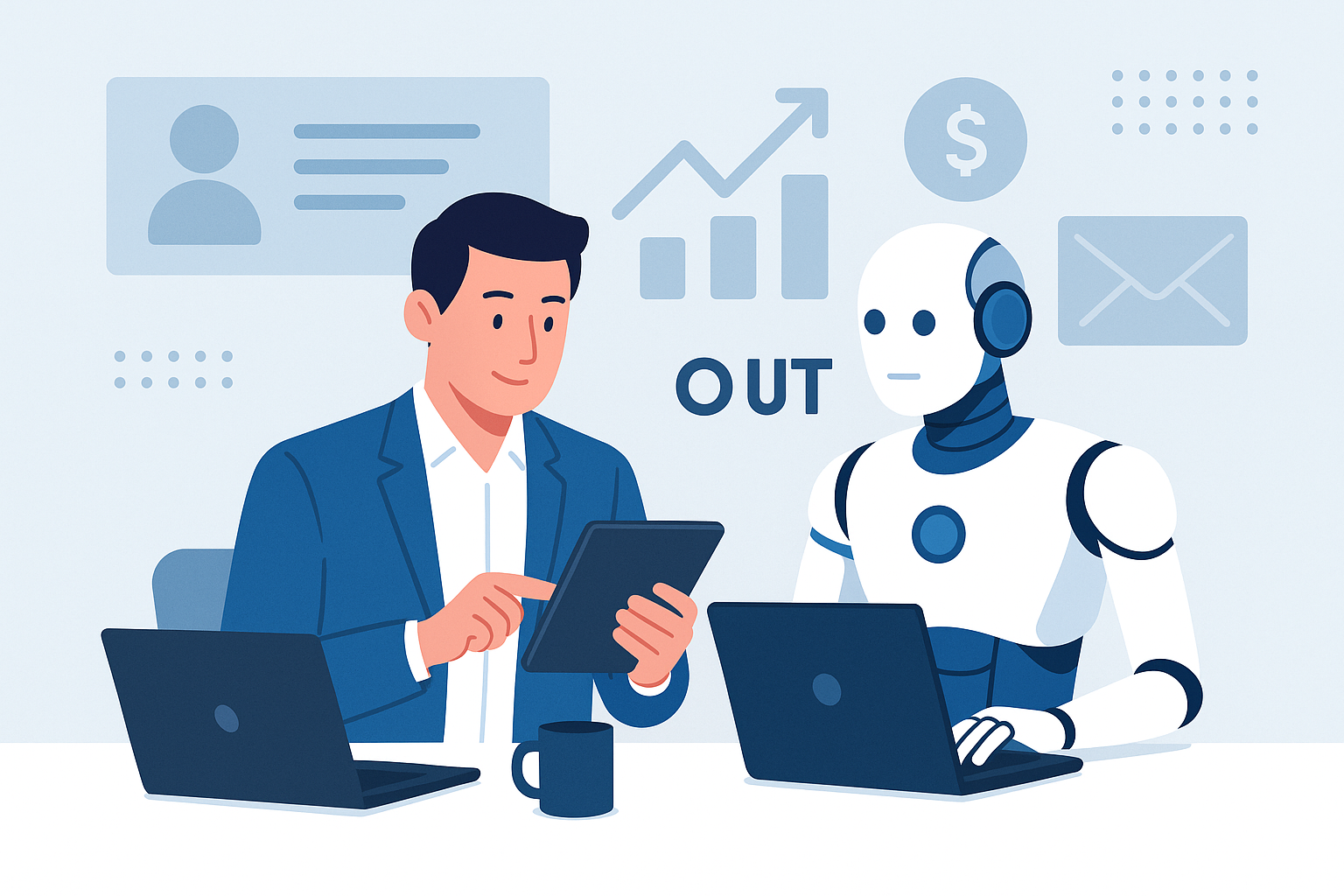
Practical Artificial Intelligence Agents as Employees for Outbound: 2026 Google Advances & A Business-Ready Playbook
Hook: "Practical artificial intelligence agents as employees for outbound" describes autonomous, task-focused AI instances that act like team members-conducting outreach, qualifying leads, scheduling, and sequencing touchpoints with measurable SLAs. This article delivers business-ready guidance tied to notable Google developments in 2026 so you can confidently pilot, scale, and measure AI agents in your outbound stack.
Audience: business leaders, heads of sales/marketing/growth, technical leads, and product managers evaluating automation that behaves like an employee. Below you'll find a concise 2026 news roundup, seven actionable outbound tactics, a 5-step integration tutorial, a decision framework comparing agents vs humans, practical templates and KPIs, and recommendations on ethics, compliance, and keeping your approach fresh.
Section 1 - 2026 Google News Roundup: Three advances that change agent economics
Summary: Google introduced three major capabilities in 2026 that materially affect how firms deploy AI agents for outbound work. Each advance reduces friction, improves relevance, or strengthens governance for agent-driven outreach.
1. Real-time, multimodal agent APIs for contextual outbound
In 2026 Google expanded its agent API surface to support low-latency multimodal context (text, voice, and structured CRM data) enabling agents to tailor messaging with up-to-the-second signals. For outbound teams this means agents can pull live account events, product telemetry, and meeting notes to craft highly relevant outreach at scale.
2. Built-in agent orchestration and evaluation in Vertex AI
Google enhanced orchestration features-task routing, fallback policies, and evaluation hooks-making it easier to run multiple agent personas (e.g., SDR-agent, Nurture-agent, Demo-scheduler) while logging decisions for audit and A/B evaluation. That shift turns agents from prototypes into auditable employee-like components.
3. Privacy-preserving data tools and synthetic-data enhancements
Responding to enterprise demand, Google pushed privacy-first tooling in 2026: federated learning connectors, labeled synthetic data generation tuned for CRM schema, and automated data minimization pipelines. These reduce legal friction when training agents on customer or prospect data while keeping personalization effective.
Business implication: Together, these advances let organizations run practical artificial intelligence agents as employees for outbound with lower risk, stronger relevance, and simpler governance.
Section 2 - Seven actionable outbound tactics you can implement this quarter
Below are ready-to-implement tactics that use agent capabilities to improve conversion, speed, and cost-efficiency.
-
Email personalization at scale
Use agent templates with dynamic placeholders and account-level insights. Let agents pull the latest product usage signal or content consumption and insert two short personalized sentences. Limit personalization to 1-2 unique facts to avoid overfitting and hallucinations.
-
Multichannel sequencing with channel-aware cadences
Orchestrate a sequence where the agent decides channel next-step based on response likelihood (e.g., if email open rate < 10%, shift to LinkedIn InMail at day 4). Set rules for cadence pacing and cooling-off windows to comply with best-practice contact frequency.
-
Automated lead qualification and handoff
Agents perform an initial qualification sequence (3-4 touches) and score leads using observable intent signals and conversation outcomes. Define clear handoff triggers (e.g., lead score > 70 or explicit meeting request) to human reps with contextual briefings generated by the agent.
-
Dynamic messaging based on journey stage
Segment prospects by lifecycle and let agents adapt tone and CTA. Early-stage = discovery questions; mid-stage = use-case case studies; late-stage = ROI or pricing playbooks. Use short templates with variable-driven modular content blocks.
-
Built-in testing and evaluation frameworks
Run multi-armed experiments where agents A/B test subject lines, opening sentences, or offer types. Use evaluation hooks (from Google’s 2026 orchestration updates) to capture response quality and lift on pipeline metrics, not just opens/clicks.
-
Scaling with persona-driven agent fleets
Deploy specialized agent personas-SDR-agent for cold outreach, Nurture-agent for content follow-up, Renewal-agent for contract reminders. Orchestrate at scale by limiting each agent’s domain to specific tasks to reduce risk and improve predictability.
-
Continuous monitoring and guardrails
Instrument content safety checks, brand-compliance filters, and escalation policies. Log every outgoing message and maintain human review loops for unusual responses or high-value accounts.
Section 3 - 5-step integration tutorial: pilot to rollout
This practical roadmap takes you from concept to production-ready agent employees for outbound.
-
Step 1: Define requirements and success metrics
Decide which outbound tasks to automate (e.g., initial outreach, qualification, scheduling). Set KPIs: qualified leads/week, response rate lift, cost per qualified lead, handoff time. Get stakeholder alignment: legal, sales ops, engineering, and reps.
-
Step 2: Prepare data and tooling
Inventory CRM fields, conversation history, product telemetry, and consent flags. Build data pipelines into a secure store (BigQuery or equivalent) and apply data minimization. Use synthetic data tools to augment rare-event scenarios for training.
-
Step 3: Train and configure agents
Create persona definitions, allowed action lists, and reply templates. Fine-tune models or configure prompt strategies using your chosen LLM and guardrail libraries. Use policy layers for tone, privacy, and escalation rules. Validate on a sandbox set of accounts.
-
Step 4: Orchestrate workflows
Implement orchestration with queued task routing, retry/cooldown logic, and cross-channel decisioning. Include transparent logging and human-in-the-loop checkpoints for high-value accounts. Use observability tools to trace decisions back to inputs.
-
Step 5: Measure, iterate, and roll out
Run a time-boxed pilot (4-8 weeks) with matched control groups. Track primary KPIs and conversation quality. Iterate messaging, thresholds, and escalation rules. Gradually expand agent permission scopes as confidence and compliance documentation grow.
Section 4 - Decision framework: agents vs humans across three outbound tasks
Not every task should be automated. Use this comparison to decide when to deploy practical artificial intelligence agents as employees for outbound.
Task A: Cold outreach (initial contact)
- Agent strengths: Scale, consistent cadence, fast coverage of broad lists, cheap iteration.
- Human strengths: Complex rapport-building, handling nuanced objections, enterprise negotiations.
- Recommendation: Deploy agents for tiered cold outreach with strict handoff triggers to humans when prospect engagement indicates high fit.
Task B: Lead qualification
- Agent strengths: Rapid, consistent qualification scripts, data-driven scoring, 24/7 availability.
- Human strengths: Pattern recognition on complex signals, relationship judgement, cross-sell insight.
- Recommendation: Use agents to qualify and enrich leads; route nuanced or high-scoring leads to human reps with agent-generated context.
Task C: Scheduling and follow-ups
- Agent strengths: Reliable scheduling, follow-up automation, personalized reminders.
- Human strengths: Handling reschedules with diplomacy or negotiating special terms.
- Recommendation: Fully automate scheduling and standard follow-ups; escalate exceptions to a human coordinator.
ROI / Task-fit checklist
- Volume: Is the task high-volume or repetitive?
- Complexity: Does the task require nuanced judgement or emotional intelligence?
- Value per contact: Is the expected revenue per interaction high enough to justify human touch?
- Compliance risk: Does the task involve sensitive personal data or legal risk?
- Measurement clarity: Can success be measured with objective KPIs?
Score each item; high-volume + low complexity + clear KPIs = prime candidate for agent deployment.
Section 5 - Practical examples, templates, KPIs, and tooling
Short case scenarios
Scenario 1: SaaS startup (mid-market) - Deploy an SDR-agent to reach 2,500 inbound trial signups weekly. Outcome: agent qualifies 60% of trials for human SDR handoff; reduces human time spent per lead by 40%.
Scenario 2: Enterprise GTM - Use persona-based agents for account-based sequences; agents push tailored content and escalate signals to account owners for high-intent triggers.
Message templates (short & business-ready)
Email outreach template (cold):
Subject: Quick question about {{recent-event}}
Hi {{first_name}},
I noticed {{company}} recently {{signal}}. We helped a similar team reduce {{pain}} by {{metric}}. Would you be open to a 15-minute call to explore whether this is relevant?
- {{agent_name}}, on behalf of {{company}}
Qualification message (chat or email):
Thanks for your interest, {{first_name}}. Can I ask: what’s your primary objective right now-improving conversion, reducing churn, or lowering costs? This helps me route you to the right expert.
KPIs to track
- Response rate (by channel)
- Qualified leads generated per week
- Hand-off conversion rate (agent -> human conversion)
- Time-to-first-response
- False-positive/false-negative qualification rate
- Cost per qualified lead
- Customer-reported message quality (survey)
Suggested Google and third-party tooling
- Google Cloud / BigQuery - secure data storage and analysis
- Vertex AI - model hosting, agent orchestration, and evaluation hooks
- Google Workspace APIs - calendar scheduling and email dispatch
- Salesforce / HubSpot - CRM integration for lifecycle signals
- Outreach / Salesloft - cadence control and activity syncing
- Zapier / Workato - lightweight orchestration between systems
- Third-party evaluation & safety libraries - for brand and compliance filters
Section 6 - Recommendations, ethics, and keeping content fresh
Expert best practices
- Start with a narrow scope: one agent persona, one cadence, and clear success metrics.
- Build auditable logs: preserve inputs, decisions, and outputs for review.
- Human-in-the-loop: always include fast escalation paths for exceptions and high-value accounts.
- Use modular messaging blocks: maintain one source of truth for legal/brand snippets.
Privacy, security, and compliance
Adopt data minimization: only surface attributes necessary for personalization. Use opt-in signals and maintain consent records. If you rely on customer data, use privacy-preserving tooling (federated learning, differential privacy) and consult legal teams for cross-border data flow and marketing regulations.
Keeping content fresh and avoiding rehash
To avoid stale coverage and repetitiveness:
- Continuously instrument which content modules drive downstream pipeline value and rotate low-performing modules.
- Use live-signal enrichment so agents reference recent account activity instead of static canned lines.
- Invest in synthetic scenario tests and adversarial message reviews to reduce drift and repetition.
- Schedule quarterly model and prompt reviews tied to real KPIs rather than calendar-only refreshes.
Final note: Practical deployment of artificial intelligence agents as employees for outbound is now accessible thanks to the 2026 Google advances in real-time context, orchestration, and privacy tooling. Start narrow, instrument everything, and expand as ROI and governance align.
Consider trying this approach and documenting the outcomes so your team can iterate faster and with confidence.
Internal resources: Agent solutions overview | Resources & templates
Meta description ideas (pick one):
- How to deploy practical artificial intelligence agents as employees for outbound with 2026 Google advances-strategies, templates, and a 5-step rollout plan.